Tuesday, 23 May 2017

Candlelight Vigil, Canberra, 21 May 2017


It’s 36 years since the first signs of a devastating new epidemic were noted and reported, but that’s only one way of noting when HIV – or AIDS, as it was then – began. For us here today, it probably began on a whole series of different days. The day when someone you love told you they had been diagnosed. The day when you asked for a test, the day when you recognised a symptom. The day you received your diagnosis. Maybe for some, it could even be that day that you attended your first AIDS funeral.

I remember the day it all became real to me as vividly as yesterday. My best friend from the cradle sitting opposite me in Fitz cafĂ© in Brunswick St in 1993. That sudden lurch, that instant reframing of a cold sore that just wouldn’t heal, that recognition that her weight loss had nothing to do with fitting back into her old jeans. Then learning about T-cells, not that she had any to speak of, and the whole new world of opportunistic infections. HIV ceased then to be an abstract social and political problem. It was deeply personal.

Dr Bridget Haire - AFAO
Gabrielle died on the last day of July 1995, at age 28, and I went on to have a career in HIV.

But this is not the story I am here to tell. One of the things in Australia that we rightly celebrate is the way that our communities were organised well before there was any real evidence that AIDS would happen in Australia. Collectives of gay men met and strategized, with the organisations that were to become AIDS councils forming at the time the very first diagnoses occurred in Australia. Similarly, long before HIV had been identified as the viral agent that caused AIDS, our community media were recommending that gay men use condoms for sex. Faced with this looming threat, the shape and scale of which could not be adequately imagined, our communities were prescient, well informed, and strategic. AIDS councils appeared in every jurisdiction, advocating for condom use and for research, and – most importantly – providing the care that people living with AIDS needed. Our organisations were funded, it was whispered, because governments recognised the amazingly cost effective health services they provided by marshalling armies of volunteers from our communities to keep people out of hospital and semi-independent for as long as possible – and, of course, to have an option to die at home, if they so chose, with 24 hour care.

But these care and support services, and the adoption of condoms in a population that didn’t need contraception, were not the only remarkable social movements that occurred in the early days of AIDS. I think that we sometimes forget the extraordinary activism conducted by people living with AIDS  (now of course we would say people with HIV). But that term ‘people living with AIDS’ was in itself ground breaking.  It symbolised the refusal to accept a diagnosis of HIV or AIDS as a kind of social death that prefigured literal death. ‘Social death’ is a chilling concept from medieval times where people with life threatening illness become objects of pity or fear, socially defined by their presumed imminent death.[1] In medieval societies, this social death was actualised for people with Hansens’ disease (leprosy): the banishment of a person showing symptoms of Hansen’s disease to a ‘leper colony’ was marked with the performance funeral rites and mourning of social death for individuals who were cast out of society from that point.[1]

Even in the grim years of the early 80s, prior to any antiretroviral drugs, people with HIV and their communities did not accept that diagnosis equalled death – in fact one of the great slogans from those years was Act Up’s ‘Silence = Death’, a slogan that placed emphasis on social engagement and speaking out. In 1983 a coalition of people with AIDS produced the Denver principles – a deeply moving manifesto that begins with the statement, We condemn attempts to label us as "victims," a term which implies defeat, and we are only occasionally "patients," a term which implies passivity, helplessness, and dependence upon the care of others. We are "People With AIDS."[2]

The Denver principles went on to make a series of recommendations which included rejection of and activism against discrimination and stigma, the right of all people to healthcare and to the enjoyment of sex and sexuality, responsibilities to not transmit HIV onwards, to be politically active and to die and most importantly to LIVE with dignity.[2]

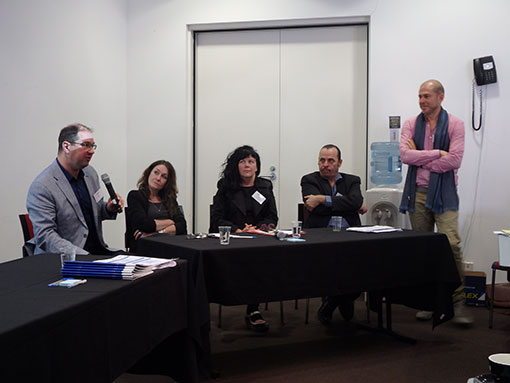
L to R: Robert Mitchell - NAPWHA, Dr Edwina Wright - the Alfred Hospital and Dr Bridget Haire - AFAO
I wonder whether the extraordinary medical advances made with combination antiretrovirals could have happened without the activism of our communities, collaborating with researchers agitating for change, and sometimes taking the rules of drug development into their own hands in instances where it was felt that promising drugs trials were not equitable enough in the access to experimental therapies that they allowed.

Here today I think we are all familiar with the idea that in 1996 everything changed. That’s when we first saw access to life saving combination antiretrovirals – though taking these drugs back then could be so complex and demanding that just taking your pills each day was practically a full-time job, let along managing side effects. In the 20 odd years since then, however, we have seen antiretroviral therapy evolve into a regimen that is as simple as it is effective.

There is less community wide recognition of 2011 as another watershed year in HIV – another year when everything changed, in terms of prevention. In late 2010, early 2011, we saw the first results not only of PrEP trials, but also evidence of the preventative efficacy of treatment-as-prevention – the now accepted fact that a viral load maintained below the level of detection, prevents onward HIV transmission. While we don’t yet have vaccine, having a form of prevention that positive people can control – their own viral loads – and one that negative people can adopt – PrEP – we have dramatically extended prevention approaches.

The response to the new understanding about the efficacy of treatment-as-prevention in Australia was exemplary – the community HIV sector, including the clinician group ASHM –  successfully changed the approval processes regarding early access to antiretrovirals to ensure that all barriers were removed to early uptake.

Our response to PrEP has been rather less effective. There’s pretty good access in NSW and QLD, promised access in the ACT, reasonable access in Victoria but with capped numbers, recruitment just beginning in SA and WA having announced an implementation trial but not yet recruiting. Some jurisdictions, Tasmania and NT – are so far missing out altogether.

This messy, piecemeal, state by state process is really not good enough for a country that has committed to ending new HIV transmissions by 2020.

The brave new world of HIV prevention is maybe more challenging than the treatment revolution of the 90s. PrEP and treatment –as-prevention has some people worried that gay men are now being ‘allowed to have unsafe sex’, forgetting that new biomedical prevention options offer effective new forms of ‘safe sex’. They will not provide perfect protection – nothing is 100 % certain, and we all know someone who knows someone who got pregnant taking the pill – but they are highly effective. Also, the role of the community sector is not to ‘tell’ anyone what they can and can’t do. Our role is to stimulate the conversations, promote awareness and understanding and to help foster sex cultures where people can negotiate the HIV prevention strategies that suit them.  For some men this will continue to include condoms, for some not, others are likely to makes strategic use of different forms of safe sex depending on relationship status and other life style factors. One size doesn’t fit all, and now there is increased freedom for the men who have hated using condoms, and whose sexual expression has been constrained by them, to talk about this and find other options.  Those for whom condoms are effective, convenient, and sexually acceptable should be supported to continue their use.

Ending HIV together is the challenge that faces us. This is more than just preventing new infections – it means a commitment to ensuring that HIV becomes as stigma free and easy to treat as other chronic diseases. It means staying aware that people who are socially and economically vulnerable may face greater challenges in practicing safe sex, getting HIV and STI tests, and accessing treatment if that is necessary. The health gap between Indigenous and non-indigenous Australians is of particular concern, given increasing rates of HIV in Aboriginal Australians.  Addressing this issue needs to be everyone’s business.

Australia’s disinvestment in HIV in our region is also an issue of great concern. At this time, when we should be building the community and health infrastructures to support HIV treatment and prevention, Australia is withdrawing. But no matter how good our responses to preventing new infections are in this country, we need to pay attention to epidemics on our doorsteps.

Finally, within Australia, we need to be very concerned at the increasing devolution of prevention to individual state jurisdictions, as the result looks like differential access to prevention goods depending on what state or territory you live in – a far cry from an integrated national response to HIV that made Australia a world leader.

We have the tools, we have the knowledge and we have the experience to take on the new challenges of ending HIV. The final question is, does the political will exist? Can we stimulate it? The marshaling of political will is, I think, the final piece of the puzzle.

Tonight we are here to remember, here to grieve, but also here to energise each other. To remember how well we have done over past decades, and to marshal that strength, that community connection, to do more, to get to the end, to put in that effort to ensure that HIV stays on the political agenda until we have actually reached those goals.

We can do it together.

Thank you.

Canberra AIDS Memorial at the National Arboretum
Dr Bridget Haire is the President of AFAO. This is the text of a speech delivered at Canberra’s Candlelight Memorial, an annual event to remember those lost to the HIV epidemic.


References
[1] Wright, Joe. 2013. "Only Your Calamity: The Beginnings of Activism by and for People With AIDS."  American Journal of Public Health 103 (10):1788-1798. doi: 10.2105/ajph.2013.301381.


[2] The Denver Principles http://www.actupny.org/documents/Denver.html

Monday, 18 July 2016

YOUTHLEAD report back on the UNAIDS High Level Meeting to End AIDS


At the UN High Level Meeting to End AIDS (HLM) in New York, civil society played a vital role in advocating for the needs of key populations, in particular stressing the urgent need for the greater inclusion specific communities affected by HIV within the document.  

AFAO spoke to one of the civil society delegates at the meeting, Jeffry Acaba, about his thoughts on the outcome of the meeting and what the next steps for civil society organisations will be.

Friday, 10 June 2016

Report back: UN High Level Meeting on AIDS

L-R: Darryl O'Donnell, Sharon Lewin,
Cipri Martinez.
It’s been an intense few days in New York, as government heads of state, ministers of health and civil society congregated in New York for the High Level Meeting on Ending AIDS (HLM).

The Australian Delegation to the meeting included AFAO CEO Darryl O’Donnell; President of the National Association of People with HIV Australia (NAPWHA), Cipri Martinez; and leading Australian HIV cure researcher and head of the Doherty Institute, Professor Sharon Lewin.

AFAO's Finn O'Keefe reports.

Friday, 13 May 2016

PrEP can help us end HIV


It’s not often that a drug’s product information sheet would be cause for excitement, let alone celebration, writes AFAO Executive Director Darryl O'Donell. 

Yet just as experts met in Sydney on 6 May to discuss HIV pre-exposure prophylaxis, Australia’s drug regulator quietly changed the product sheet for the drug Truvada to approve its use to prevent HIV.

This change by Australia’s Therapeutic Goods Administration means that doctors can now write a script for Truvada and it can be dispensed at a chemist. This is groundbreaking because it means Australia’s drug technocrats have said that Truvada is safe, and that it works in preventing sexual transmission of HIV.  

Friday, 20 November 2015

Charlie Sheen: Commentary from Australian HIV advocates

On 17 November the news broke that actor Charlie Sheen was about to do an interview in which he would disclose that he had HIV. 

On 18 November this rumour was confirmed, with Sheen announcing that he had been living with HIV since 2011, had an undetectable viral load, and had been blackmailed to the tune of millions of dollars by people to whom he’d disclosed.

Social and online media exploded, and concern about the potentially stigmatising impact on people with HIV was uppermost in the minds of HIV advocates around the world. Organisations such as AFAO and our members rapidly put out media statements or circulated information to encourage the media to report sensitively.

On the positive side, the media circus provided an opportunity to raise awareness about HIV and publicise accurate information to counter the decades-old myths that still circulate.

This blog post links to Australian community media and HIV sector responses to Charlie Sheen’s disclosure.

If you have links to other useful Australian stories commenting on Charlie Sheen, please post them in the comments.

Friday, 30 October 2015

HIV video fest

Mini film festivals were a key part of the Community and Advocacy Hubs hosted by AFAO at ASHM’s last two national HIV conferences, and also at AIDS 2014. 

This year, once again, we had an awesome selection of videos from our members and other HIV sector partners, with the videos running on a continuous loop between Hub presentations.

Here’s a selection from the program. There were so many that we can’t share them all, so make sure you click through to the organisations’ channels for more.

Friday, 16 October 2015

Raise your voice against stigma and homophobia

Speaking out against prejudice is a vital step towards changing community attitudes that stigmatise people with HIV and people who are at greater risk of contracting HIV.
When people raise their voices against stigma, it makes it easier for people who have HIV, who are gay, who use drugs, or are sex workers, to access the information, prevention tools, and treatments and care that they need to stay safe and well. Faith leaders play a critical role in the response to HIV through model compassion and supporting evidence-based approaches to HIV prevention and care.

Thursday, 15 October 2015

AFAO Hub buzzes at ASHM 2015

The AFAO Community and Advocacy Hub was an exciting and stimulating focal point of the national HIV (ASHM) Conference in Brisbane over 17 and 18 September. 


Hundreds of conference delegates enjoyed a wide range of presentations, Q & A sessions and film screenings.

AFAO's Michael Frommer reports back.

Monday, 7 September 2015

JumpStart: building the capacity of MSM and transgender networks across Asia and the Pacific

The APCOM team, led by Joe and A, present JumpStart
findings to Khun Somchai Promsombat, Executive Director
at the Poz Home Center.
JumpStart is an AFAO/APCOM project, which aims to build the capacity of MSM and transgender national networks to effectively engage with HIV responses in the Greater Mekong and ISEAN sub-regions.

In 2015, JumpStart published a Regional Analysis Report assessing the capacity of regional, sub-regional and national MSM and transgender organisations and networks working across Asia and the Pacific.

Monday, 27 July 2015

Don't leave Indigenous communities behind: Marama Pala closes IAS 2015

Marama Pala, IIWGHA CO-Chair,  at the closing of IAS 2015

AFAO's Ben Wilcock reports back from the closing of IAS 2015.

After summaries of the four main tracks of the conference were presented in the closing session of the #IAS2015 conference, the conference attendees had the honour of being present for an inspiring talk by Marama Pala, Co-Chair of the International Indigenous Working Group on HIV & AIDS (IIWGHA).

A Cure For All: 2nd International HIV/Viral Hepatitis Co-infection Meeting


AFAO Health Promotion Officer, Ben Wilcock, reports back on the 2nd International HIV/Viral Hepatitis Co-infection Meeting, held in Vancouver.

On Friday and Saturday (17-18 July), I was fortunate to be able to attend the 2nd International HIV/Viral Hepatitis Co-infection Meeting in Vancouver. It was an official event before the IAS Conference on HIV Pathogenesis, Treatment and Prevention (#IAS2015).

There were a range of issues covered relating to HIV and viral hepatitis co-infections (both hepatitis B and C), with a particular focus on building momentum towards expanding hepatitis C treatment access globally for people co-infected with HIV and viral hepatitis, in the light of the new range of direct-acting antiviral (DAA) treatments for hepatitis C now available (though often not yet accessible) and in the pipeline. (See: #ACureForAll for more info).

Thursday, 23 July 2015

IAS 2015: Reaching 90-90-90

AFAO Policy Analyst, Michael Frommer discusses day one of IAS 2015.

Questions about the best way to facilitate access to testing in order to reach the UNAIDS target of 90% of people with HIV diagnosed was a recurring theme in sessions on the first day of IAS 2015,  Vancouver.

Future directions of the IAS: share your views

IAS2015 at the Vancouver Convention Centre


The International AIDS Society (IAS) is engaging with stakeholders to help develop a new strategic plan.

During the IAS 2015 conference, the International AIDS Society has been holding a series of strategic planning consultations with members, as well as calling for input via an online Membership and Strategy Survey.

A key issue in the consultation for the new IAS 2016-2020 plan is what balance is struck between its three key missions; representing HIV professionals; convening the IAS conferences; and engaging in advocacy.  

Tuesday, 21 July 2015

IAS 2015: Disclosure and HIV criminalisation advocacy

Alison Symington, Canadian
HIV/AIDS Legal Network.
The 8th IAS Conference on HIV Pathogenesis, Treatment and Prevention (IAS 2015) is on in Vancouver, Canada, this week. AFAO Policy Analyst Michael Frommer reports back on the pre-conference community forum. 

Key human rights challenges, such as criminalisation of HIV transmission, were centre stage at the IAS community forum on Saturday 18 July.

Alison Symington, co-director of Research and Policy at the Canadian HIV/AIDS Legal Network (Legal Network), described the challenge of advocacy and policy work in Canada in the face of ongoing criminalisation.

Friday, 3 July 2015

Support Don’t Punish Day of Action

There was resounding agreement that the 'War on Drugs' has failed at the AIVL/NUAA day of action celebrating the global movement Support Don’t Punish

L to R: Leah McLeod - NUAA, Peter Baume AC, Nicholas Stewart - Dowson Turco, Jude Byrne - AIVL, Will Tregoning - Unharm
Held at NSW Parliament on 26 June, the impressive range of speakers included ex federal Senator Peter Baume – renowned for the key role he played in fostering a constructive political response to HIV in the late 1980s, Jude Byrne from the Australian Injecting and Illicit Drug Users League (AIVL), Nicholas Stewart, a private legal practitioner and volunteer lawyer at Sydney’s Inner-City Legal Centre, and Will Tregoning from Unharm – a drug law reform advocacy organisation.


Monday, 29 June 2015

HIV: a conversation in dance

James Welsby, Chafia Brooks and Benjamin Hancock.
Photo: Gregory Lorenzutti 
'HEX' is a one hour contemporary dance show that looks at the AIDS crisis of the 1980s and early 1990s from a Gen Y perspective. 

Guest blogger and dance maker James Welsby explains how the show came about.

I've known about ACT UP (the AIDS Coalition to Unleash Power) for a while, but the recent release of a few core-shaking documentaries made of archival footage has allowed me to take a much closer look at the movement and get a stronger idea of what it felt like to be involved in AIDS activism.

Monday, 22 June 2015

Doing Debby in Darlinghurst

A print in Difficult Debby's
Whore Love series.
In early June, a collective of sex worker artists who call themselves Debby Doesn't Do It For Free hosted an exhibition of new and old artworks in Darlinghurst, Sydney. 

Difficult Debby explained what it was all about in her post on this blog in the lead-up to the exhibition.

Once the exhibition opened, AFAO Project Officer Jill Sergeant went along. In this photo-essay she shares her experience at a special viewing session for allies to sex workers.


Tuesday, 2 June 2015

Advocacy and updates: AFAO Members Forum day two

Craig Cooper from Positive Life NSW opened day two of forum with an update about community dispensing of ARVs  in NSW.

On Day two of the Forum, participants posed for a photo in solidarity with the
International Day Against Homophobia & Transphobia


HIV testing: AFAO Members Forum


The second session of the AFAO Members Forum explored various testing options and innovative approaches which have increased HIV testing rates among communities.


'Beyond the targets': AFAO Members Forum 2015 session one

Day one of the AFAO Members Forum opened with ‘Beyond the targets’, a session focusing on research as a tool to leverage policy goals for the sector.